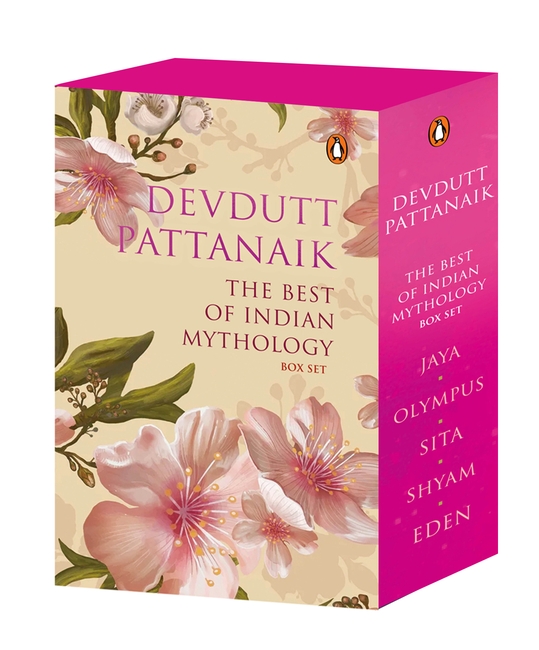
The Best of Indian Mythology (boxset of 5)
€ 60,00
Author: Devdutt Pattanaik
Cover: Paperback
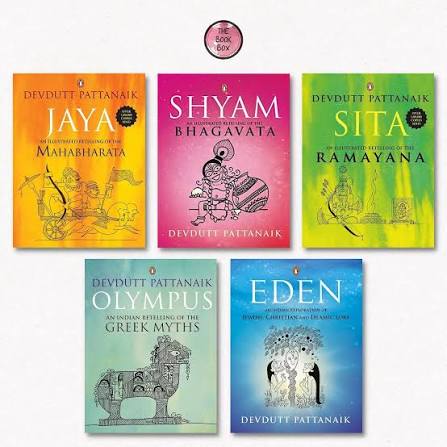
Set of 5 books, includes:
1) Jaya
Jaya: An Illustrated Retelling Of The Mahabharata has the whole epic, which was originally known as Jaya, condensed into a tiny capsule in this book. Other than retelling the interesting parts of the Mahabharata, what makes this book a favourite among the readers is Pattanaik rendering of the various local folklores and tales that are associated with the epic, which have been presented in a whole new genre. With a master stroke, the author has elaborated the storyline by including lesser known folklore stories of the epic, while keeping intact its original form and style.
The book has been divided into 108 chapters and has vivid illustrations along with 250 simple line drawings painted by Pattanaik himself. Besides infusing the different tales from local versions of the epic, the author has also added folk arts aspects picked up from ‘Yakshagana’ in Karnataka, ‘Terukuttu’ in Tamil Nadu and ‘Pandavani’ in Chattisgarh to blend with the narrative. Stories of Barbareek, Aravan, Astika, Madhavi and Jaimini form a special portion of this book. Other than this, Pattanaik has also introduced some intriguing ongoing traditions, like the worship of Draupadi in temples of Tamil Nadu.
Along with this, a whole section has been devoted to the Kurukshetra war described on the basis of descriptive astronomical information. By infusing these interesting details along with the various local versions of the epic, the author has attempted to create a pan-Indian version of the epic that has, since times immemorial, helped in shaping the culture and history of the whole country.
2) Olympus
Olympus is the home of the Greek gods, much like Amravati of the Hindu devas. Zeus, leader of Olympians, wields a thunderbolt like Indra, and rides an eagle like Vishnu. The feats of the Greek hero Heracles, known to Romans as Hercules, reminded many of Krishna, as did his name, ‘Hari-kula-esha’ or lord of the Hari clan. The Greek epic of a husband sailing across the sea with a thousand ships to bring his wife, Helen, back from Troy seems strikingly similar to the story of Ram rescuing Sita from Lanka.
Is there a connection between Greek and Hindu mythology then? Does it have something to do with a common Indo-European root? Or maybe an exchange of ideas in the centuries that followed the arrival of Alexander the Great, when Greek emissaries travelled to the kingdoms of Mathura and Magadha? In this book, mythologist Devdutt Pattanaik turns his attention to ancient Greek tales, and explores a new world of stories. Long have Europeans and Americans retold Indic mythologies. It is time for Indians to reverse the gaze.
3) Sita
Sita: An Illustrated Retelling of Ramayana is an epic story based on the life of India’s most admired prince- ‘Rama’ and his wife ‘Sita’. Ramayana is a mythological story, which is being passed on from past many generations. Since ages, the character that is most emphasized has been that of Rama, who has always been known to keep his word whatever be the circumstances. The role of Sita has been generally overlooked in the past. Sita too is a pivotal character being a single mother; she went through many ups and downs all alone. Still, she has often been portrayed as a frail and meek character.
In the present book, the author has emphasized on this very fact that Sita, though shown as a submissive character, was a woman who had massive strength. In the book, the author has shown Sita’s childhood in a more detailed manner. Her relationship with her father, king Janaka, who was a very sober and spiritual person, Sita’s forest stay with her husband and after that her lone stay, her connection and conversations with the women in Lanka, at the ‘Ashoka Vatika’, the sentiments that were shared amongst them. Also, depicted is her attachment with her sisters, with the trees in the forest, as she loved her life in forest, her bond with the mother earth. This book has portrayed Sita in a fair and magnanimous way, along with restating the whole story of Ramayana.
4) Shyam
In the forest of insecurities, is it possible to discover humanity through pleasure? Can we stop seeing each other as predator, prey, rival or mate, and rediscover ourselves as lovers? Does the divine reside in sensual delight, in emotional intimacy and in aesthetic experience? Yes, yes, yes. That is the promise of the Bhagavata.
The Bhagavata is the story of Krishna, known as Shyam to those who find beauty, wisdom and love in his dark complexion. It is the third great Hindu epic after the Mahabharata and the Ramayana. However, this narration was composed in fragments over thousands of years, first as the Harivamsa, then as the Bhagavata Purana, and finally as the passionate songs of poet-sages in various regional languages. This book seamlessly weaves the story from Krishna’s birth to his death, or rather from his descent to the butter-smeared world of happy women to his ascent from the blood-soaked world of angry men.
5) Eden
Eden is the garden of happiness that humanity was cast out of when Adam and Eve, the first human couple, disobeyed the one true God, and ate the fruit of the forbidden tree. To this garden we shall return if we follow God’s law and accept God’s love, conveyed through his many messengers, the first of whom was Abraham. This is the essence of Abrahamic lore that emerged over 3000 years ago in the Near East, blossomed in the Middle East, and has since spread to every corner of the world in three forms:
Judaism, that still awaits the final messenger.
Christianity, that views Jesus Christ as the final messenger and the Son of God.
Islam, that views Muhammad as the final messenger.
In his uniquely Indian style of storytelling, intimate but not irreverent, Devdutt Pattanaik introduces the readers to the many tales of angels, demons, prophets, patriarchs, judges and kings. It also retells stories from Mesopotamian, Egyptian and Zoroastrian mythologies that influenced Abrahamic monotheism in its long 5000-year-old history.